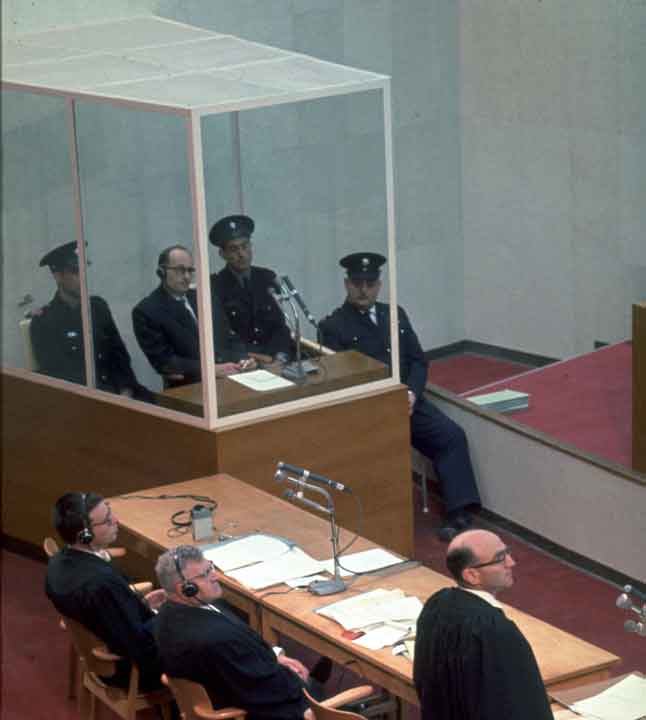
Adolf Eichmann was the SS officer who served as the chief bureaucratic organizer of the Holocaust, coordinating the transport of millions of Jews to the Nazi death camps. Born in the German Rhineland and raised in Austria, he was an unremarkable young man who joined the Austrian Nazi Party and the SS in the early 1930s.
Within the SS security apparatus, Eichmann made himself an expert on "Jewish affairs" and emigration. After the 1942 Wannsee Conference, at which the Nazi leadership planned the "Final Solution," he was placed in charge of the logistics of genocide — organizing the round-ups, the schedules, and the trains that carried Jews from across occupied Europe to Auschwitz and the other killing centers. He pursued this task with chilling efficiency, notably in the deportation of Hungary's Jews in 1944.
At the end of the war Eichmann escaped from American custody and, with the help of a Nazi escape network, fled to Argentina, where he lived in hiding for years under a false name.
In 1960 Israeli agents tracked him down and abducted him to Israel, where he was put on trial in Jerusalem in a proceeding watched around the world. His defense — that he was merely a functionary following orders — prompted the philosopher Hannah Arendt's famous phrase about the "banality of evil." Convicted of crimes against humanity, he was hanged in 1962.