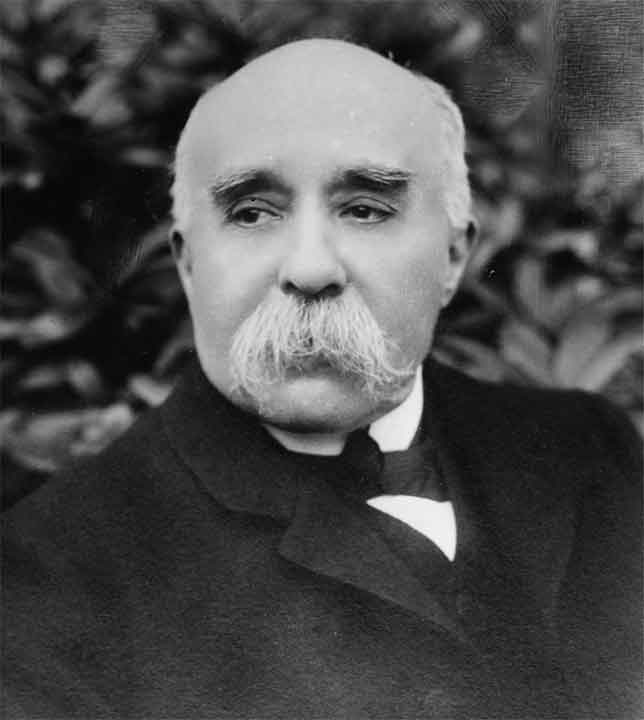
Georges Clemenceau, known as "the Tiger," was the fiercely combative French statesman who led his country to victory in the First World War and dominated the peace that followed. Trained as a physician, he entered politics as a young radical, serving as mayor of the Montmartre district of Paris during the turbulent days of 1871, and went on to a long career as a journalist and republican deputy famous for toppling governments.
A passionate defender of the Republic and of individual liberty, Clemenceau won admiration for his courageous role in the Dreyfus Affair, championing the unjustly convicted Jewish officer when it was unpopular to do so. He served a first term as premier in the years before the war, earning a reputation as a tough, anti-clerical reformer and a hard-driving leader.
His greatest hour came in 1917, when, at the age of seventy-six and with French morale collapsing under the strain of the war, he was recalled as premier. With ferocious energy and an absolute determination to win, he rallied the nation, declared that his policy was "to make war," and held France together through to the Allied victory of 1918.
At the Paris Peace Conference, Clemenceau fought to secure French security against Germany, pressing for harsh terms in the Treaty of Versailles and clashing with the idealistic American president Woodrow Wilson. Defeated in a bid for the presidency in 1920, he retired from politics and died in 1929.