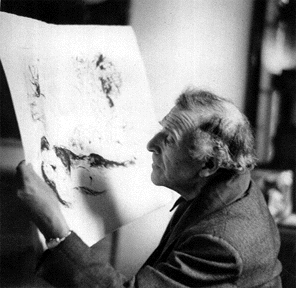
Marc Chagall was one of the most beloved and distinctive artists of the twentieth century, a painter whose dreamlike, poetic images — floating lovers, fiddlers on rooftops, flying figures, and brilliant color — drew on the folklore of his Russian-Jewish childhood. Born near Vitebsk in the Russian Empire, in a devout and impoverished Hasidic Jewish community, he carried the memories of that world with him throughout his long life.
As a young man Chagall moved to Paris, then the center of the art world, where he encountered the modern movements of Cubism and Fauvism but absorbed them into a wholly personal style. His paintings hovered between dream and memory, defying ordinary logic and gravity, filled with images from his hometown, Jewish tradition, the circus, and the Bible, rendered in luminous, jewel-like color.
His life was shaped by the upheavals of his century. He returned briefly to Russia during the revolution, then settled again in France, only to flee to the United States during the Second World War to escape the Nazi persecution of the Jews. The loss and exile of those years deepened the bittersweet tenderness of his art.
In his later decades Chagall worked on a grand public scale, creating celebrated stained-glass windows for cathedrals and synagogues, vast murals, mosaics, and the painted ceiling of the Paris Opera. Endlessly productive into great old age, he died in 1985, his joyous, melancholy vision making him one of the most popular artists of modern times.