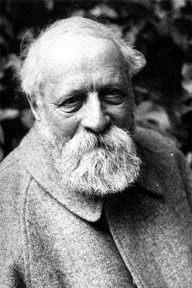
Martin Buber was one of the most influential religious philosophers of the twentieth century, a Jewish thinker whose ideas about dialogue and human relationship reached far beyond his own faith to shape modern theology, philosophy, and education. Born in Vienna and raised partly by his grandfather, a distinguished scholar, he was steeped from childhood in Jewish learning while also absorbing the wider currents of European thought.
Buber's most celebrated work, the short and poetic book I and Thou, published in 1923, set out the central idea for which he is remembered. He distinguished between two fundamental ways of relating to the world: the "I–It" relationship, in which we treat others as objects to be used or analyzed, and the "I–Thou" relationship, a genuine, mutual encounter in which we meet another being in its full reality. For Buber, it was in such authentic dialogue that human life found meaning and that the divine could be glimpsed.
He drew deeply on the tradition of Hasidism, the mystical movement of Eastern European Jewry, retelling its tales and interpreting its spirit for a modern audience. A committed cultural Zionist, he advocated reconciliation and coexistence between Jews and Arabs in Palestine.
With the rise of Nazism Buber fled Germany, where he had taught and worked to sustain Jewish cultural life, and settled in Jerusalem, becoming a professor at the Hebrew University. He continued to write and teach on philosophy, religion, and society until his death in 1965, his thought a lasting influence on thinkers of many traditions.