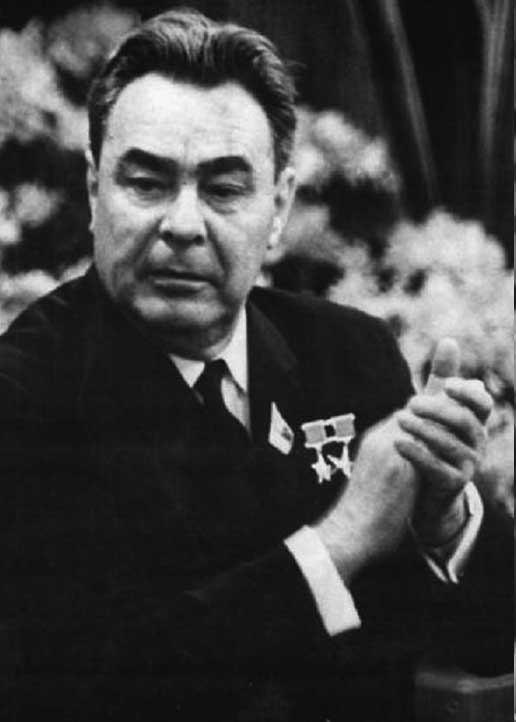
Leonid Brezhnev was the Soviet leader whose long rule came to symbolize both the superpower confidence and the creeping stagnation of the Soviet Union in its later decades. Born in Ukraine, he trained as a metallurgist and land surveyor before making his career in the Communist Party, rising through the ranks during the Stalin era and serving as a political officer during the Second World War.
In 1964 Brezhnev took part in the coup that removed Nikita Khrushchev and emerged as the dominant figure in the Soviet leadership, a position he would hold for eighteen years. A cautious, conservative apparatchik, he restored stability and predictability after Khrushchev's erratic reforms, and the Soviet Union under his rule reached the height of its military power and global influence.
Abroad, his record was mixed. He pursued détente with the West, signing arms-control agreements with the United States, yet he also crushed reform in Czechoslovakia in 1968 — proclaiming the "Brezhnev Doctrine" that justified Soviet intervention in any wavering communist state — and in 1979 ordered the fateful invasion of Afghanistan.
At home, the long Brezhnev era brought a measure of comfort and security to ordinary citizens but also economic stagnation, pervasive corruption, and a sclerotic, aging leadership. By his final years he was visibly infirm, a symbol of a system running out of energy. He died in office in 1982, and the problems he left behind would soon force his successors toward radical change.