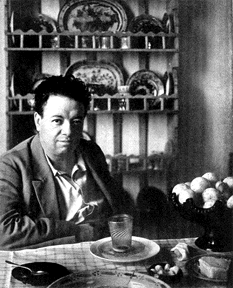
Diego Rivera was the most famous of the Mexican muralists, a towering and flamboyant artist whose vast public frescoes celebrated the history, labor, and revolutionary aspirations of the Mexican people. Born in Guanajuato, he showed prodigious talent as a child and studied art in Mexico City before spending years in Europe, where he absorbed the modern movements of Paris, including Cubism.
Returning to Mexico after its revolution, Rivera embraced a new mission: to create a monumental public art that would speak to ordinary people and tell the story of their nation. Working on the walls of government buildings, schools, and palaces, he painted huge, crowded frescoes depicting Mexican history, indigenous civilization, peasant life, industry, and the struggle of workers against oppression, blending grand realism with bold design.
A committed communist, Rivera filled his work with political conviction, glorifying labor and revolution. His fame carried him north to the United States, where he painted celebrated murals in Detroit and elsewhere. One commission ended in scandal when his mural at New York's Rockefeller Center, which included a portrait of Lenin, was destroyed by its patrons.
His tempestuous personal life was nearly as famous as his art, above all his passionate, stormy marriage to the painter Frida Kahlo. A larger-than-life figure of enormous appetite and energy, Rivera dominated Mexican art for decades and helped make the mural movement a powerful expression of national identity. He died in Mexico City in 1957.