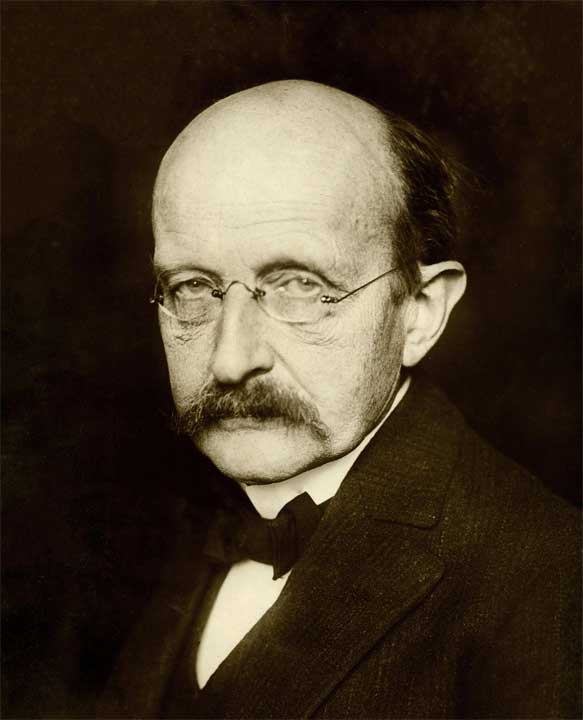
Max Planck was the German physicist whose work gave birth to quantum theory and reshaped the very foundations of physics. Born in Kiel into a family of scholars and jurists, he studied in Munich and Berlin, where he was taught by Hermann von Helmholtz and Gustav Kirchhoff. A gifted pianist who briefly considered a career in music, he chose physics despite being told the field was nearly complete, and became professor of theoretical physics at the University of Berlin in 1889.
In 1900, while studying the radiation emitted by heated bodies — the "black-body" problem that classical physics could not solve — Planck made a desperate mathematical assumption that proved revolutionary: that energy is emitted and absorbed not continuously but in discrete packets, or "quanta." The size of these packets was set by a new constant of nature now known as Planck's constant. Albert Einstein, Niels Bohr, and a generation of younger physicists built upon the idea to create the quantum revolution, and Planck was awarded the Nobel Prize in Physics in 1918.
A devoted servant of German science, Planck headed the Kaiser Wilhelm Society, later renamed the Max Planck Society in his honor. He remained in Germany under the Nazis, using his prestige to try to shield science and colleagues — including Einstein — from political persecution, with limited success.
His personal life was scarred by tragedy. He lost his first wife and several children young; his eldest son died in the First World War, and a surviving son, Erwin, was executed in 1945 for his part in the plot to assassinate Hitler. Planck died, his world in ruins, in Göttingen in 1947.