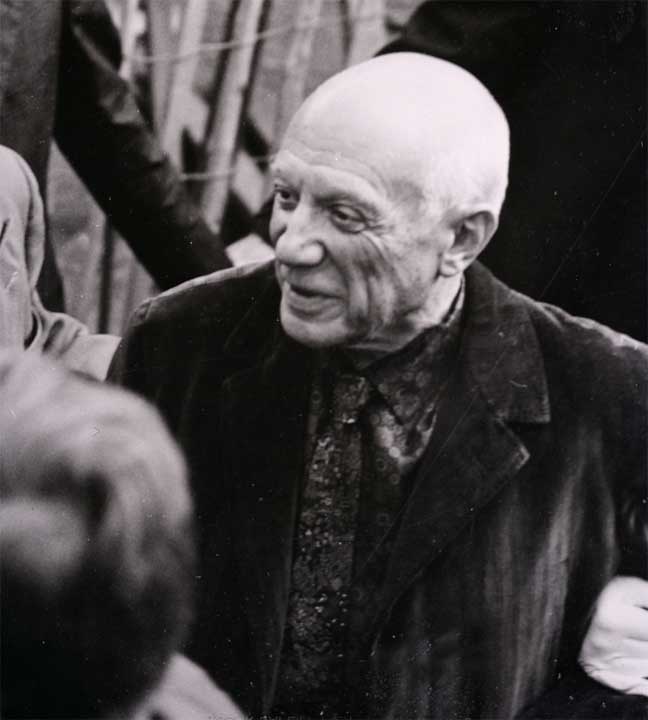
Pablo Picasso was the most influential and prolific artist of the twentieth century, a restless genius who reinvented the visual arts again and again over a career spanning more than seventy years. Born in Málaga, Spain, the son of an art teacher, he was a prodigy who mastered traditional technique as a boy before moving to Paris, the center of the modern art world.
His early work passed through the melancholy "Blue" and tender "Rose" periods, but his decisive breakthrough came around 1907 with Les Demoiselles d'Avignon, a jagged, confrontational painting that helped shatter centuries of convention. With Georges Braque he then developed Cubism, fracturing objects into intersecting planes and seeing them from multiple viewpoints at once — a revolution that transformed modern art.
Endlessly inventive, Picasso never settled into a single style; he moved through Cubism, neoclassicism, and Surrealist-tinged work, and he was a master draftsman, printmaker, sculptor, and ceramicist as well as a painter.
His most famous single work, Guernica (1937), a vast monochrome canvas depicting the bombing of a Basque town during the Spanish Civil War, became the century's most powerful artistic protest against war. Wealthy, famous, and ceaselessly productive into his nineties, with a turbulent personal life that fed his art, Picasso left a body of work numbering in the tens of thousands when he died in France in 1973.