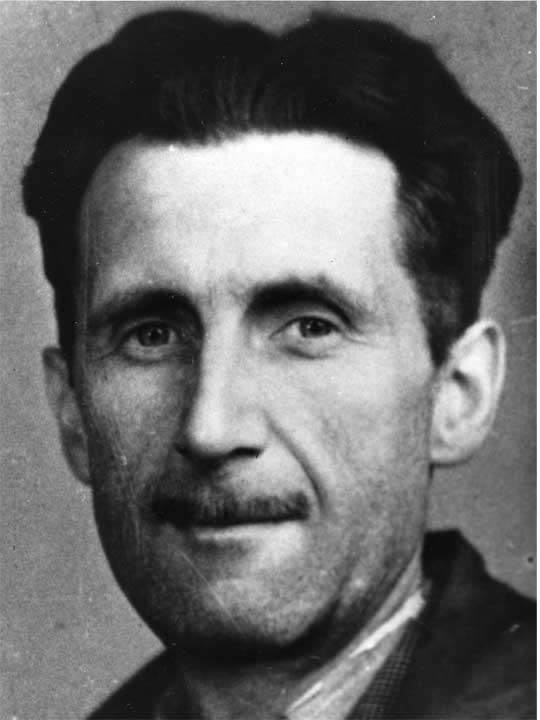
George Orwell was the English novelist, essayist, and journalist whose searing political writing — above all the novels Animal Farm and Nineteen Eighty-Four — made him one of the most influential writers of the twentieth century and added words like "Big Brother" and "doublethink" to the language. Born Eric Arthur Blair in colonial India, he was educated at Eton.
Rather than university, he served in the Imperial Police in Burma, an experience that turned him against imperialism, as he later recounted in Burmese Days. Returning to Europe, he deliberately lived among the poor and unemployed, chronicling their lives in Down and Out in Paris and London and The Road to Wigan Pier, and adopting a lifelong democratic socialism.
In 1936 he went to Spain to fight against Franco in the Civil War, was shot through the throat, and was nearly killed not by fascists but by Stalinist purges of his own side — an experience, recorded in Homage to Catalonia, that left him a permanent enemy of totalitarianism of every stripe.
This conviction produced his two masterpieces: Animal Farm (1945), a fable of the Russian Revolution betrayed, and Nineteen Eighty-Four (1949), a terrifying vision of a totalitarian future of surveillance and thought control. A peerless essayist who prized clear, honest prose, Orwell died of tuberculosis in 1950, just as his fame reached its height.