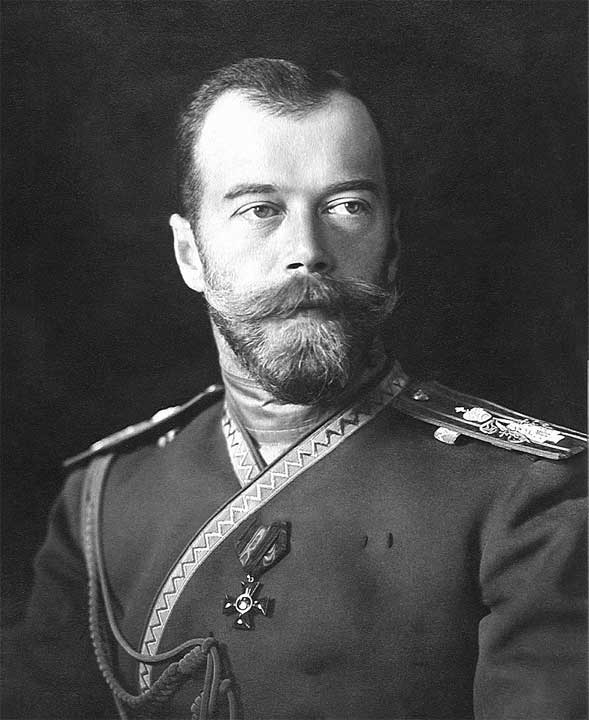
Nicholas II was the last tsar of Russia, the well-meaning but weak autocrat whose reign ended in revolution and whose family's murder closed three centuries of Romanov rule. Born near St. Petersburg, the eldest son of Tsar Alexander III, he came to the throne unexpectedly young in 1894, ill-prepared for the immense responsibilities of ruling the vast Russian empire.
A devoted husband and father but an irresolute ruler, Nicholas clung stubbornly to the principle of autocracy even as Russia strained under the pressures of modernization. His reign was marked by disaster: a humiliating defeat in the Russo-Japanese War of 1904–05, the bloody suppression of protesters, and a revolution in 1905 that forced him reluctantly to grant a parliament, the Duma, whose powers he then worked to undermine.
The royal couple's private life was shadowed by the hemophilia of their only son and by their dependence on the sinister faith healer Rasputin, whose influence over the imperial family scandalized Russian society.
The First World War proved fatal to the dynasty. Nicholas took personal command of his failing armies, leaving government in the hands of his unpopular wife, and as military defeat, hunger, and unrest mounted, the monarchy collapsed. He abdicated in March 1917, and after the Bolsheviks seized power he and his entire family were held captive and then shot in a cellar in Yekaterinburg in July 1918.