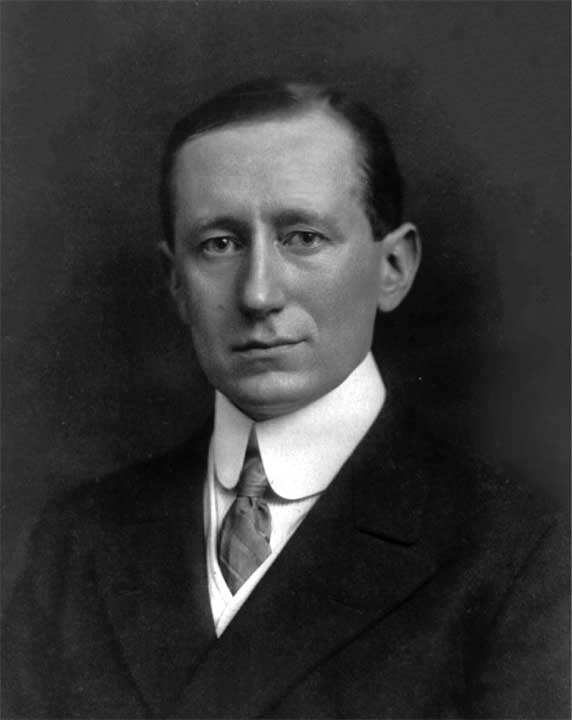
Guglielmo Marconi was the Italian inventor and entrepreneur who transformed wireless telegraphy from a laboratory curiosity into a world-changing technology, earning him lasting fame as the "father of radio." Born in Bologna to a prosperous Italian father and an Irish mother, he was educated privately and grew fascinated as a young man by recent discoveries about electromagnetic waves.
Working in the attic of the family villa, Marconi built apparatus that could send signals through the air without wires, and by 1895 he had transmitted over a mile. Finding little official interest in Italy, he moved to England, patented his system in 1896, and founded what became the Marconi Company. He steadily extended the range of his equipment, and in December 1901 he stunned the world by transmitting the first wireless signal across the Atlantic Ocean, from Cornwall to Newfoundland — a feat many physicists had believed impossible.
Wireless quickly proved its life-saving value at sea, dramatically so during the sinking of the Titanic in 1912, when radio summoned rescue ships. Marconi shared the Nobel Prize in Physics in 1909 for his contributions to wireless telegraphy, and his company grew into a global enterprise.
In his later years he pioneered shortwave and microwave transmission. He became a prominent public figure in Fascist Italy, a supporter of Mussolini who served the regime — an association that has complicated his legacy. He died in Rome in 1937, mourned with national honors.