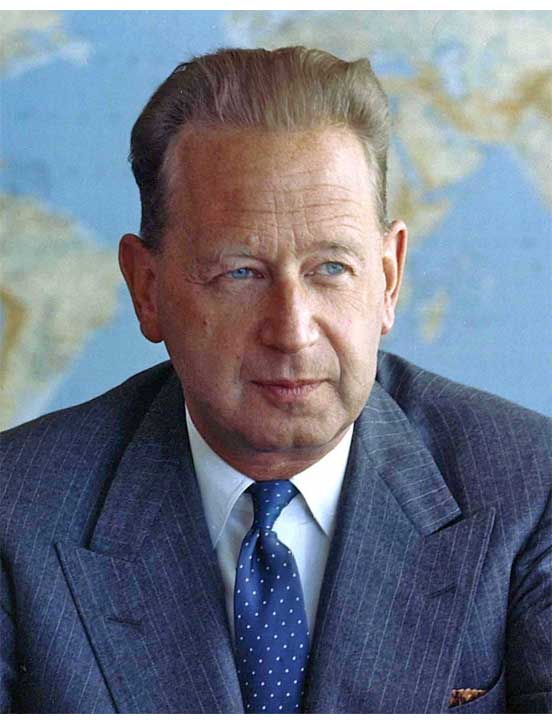
Dag Hammarskjöld was the Swedish diplomat and second Secretary-General of the United Nations, widely regarded as the ablest and most principled person ever to hold that office. Born into a distinguished Swedish family — his father served as prime minister — he trained as an economist and lawyer and rose quietly through the Swedish civil service and finance ministry before entering international diplomacy.
Elected Secretary-General in 1953, the reserved, intensely private Hammarskjöld worked to strengthen the young organization and to establish the office as an independent moral force rather than a servant of the great powers. He developed the modern concept of UN peacekeeping during the 1956 Suez Crisis, creating the first emergency force to separate combatants, and he repeatedly used "quiet diplomacy" to defuse Cold War confrontations, once flying to Beijing to win the release of captured American airmen.
His final and most dangerous undertaking was the crisis in the newly independent Congo, where he committed UN troops to prevent the country's disintegration, drawing the fury of both Cold War blocs.
In September 1961, while flying to negotiate a ceasefire, Hammarskjöld was killed when his plane crashed in Northern Rhodesia under circumstances never fully explained and long suspected of foul play. He was posthumously awarded the Nobel Peace Prize that year. His private spiritual journal, Markings, published after his death, revealed the depth of the inner life behind his public service.