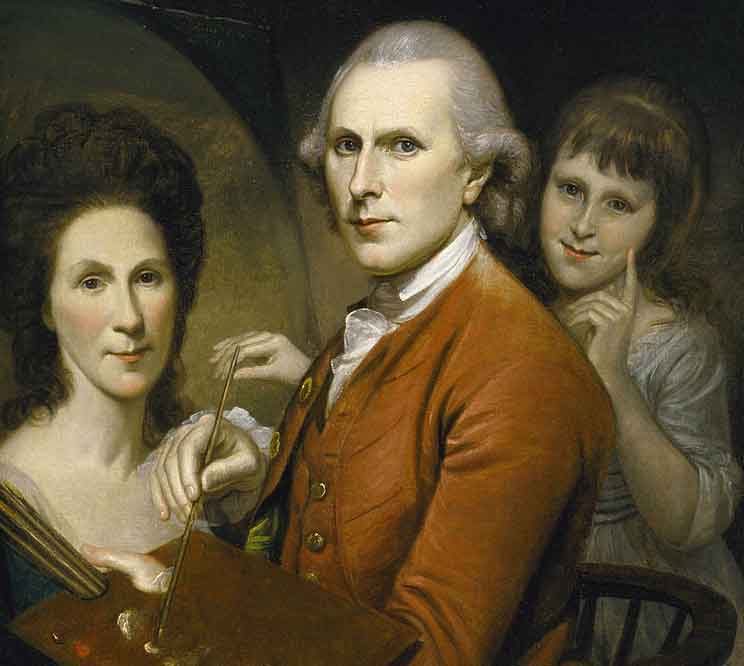
Born in Chestertown, Maryland, Peale’s early life gave little indication of the fame to come. He was apprenticed to a saddler at a young age, but his natural talents soon pushed him toward other crafts, including watch repairing and silversmithing. After finding inspiration in a few amateur paintings, he decided to teach himself how to paint.
Recognizing his immense raw talent, a group of wealthy Maryland patrons raised funds to send Peale to London in 1767. There, he studied under the famous American expatriate artist Benjamin West. When Peale returned to the colonies in 1769, he quickly established himself as a highly sought-after portraitist, capturing the likenesses of the mid-Atlantic elite.
Soldier and Portraitist of the Revolution
Peale was an ardent patriot and a firm believer in the American cause. In 1776, he moved his family to Philadelphia and joined the Pennsylvania militia. He eventually rose to the rank of captain, leading troops at the historic battles of Trenton and Princeton.
Even while on the battlefield, Peale never stopped painting. He carried a miniature painting kit with him into camp, capturing the likenesses of his fellow officers.
-
He painted the first-ever official portrait of George Washington in 1772.
-
Over his lifetime, Washington sat for Peale seven different times.
-
Peale's wartime portraits of figures like Thomas Jefferson, Benjamin Franklin, and Alexander Hamilton serve as the primary visual record of America's founding generation.
America’s First Museum and the Mastodon
Following the war, Peale’s insatiable curiosity shifted toward natural history. In 1786, he opened Peale’s Philadelphia Museum (housed for a time in Independence Hall). It was a revolutionary institution that combined fine art with scientific education, organizing animal specimens according to the newly developed Linnaean classification system.
Peale’s most famous scientific achievement occurred in 1801, when he funded and led an expedition to Orange County, New York, to exhume the bones of a prehistoric creature. He successfully assembled and displayed the first nearly complete mastodon skeleton in America. This feat sparked international fascination and fundamentally challenged contemporary European ideas about American wildlife, an achievement he immortalized in his famous painting, The Exhumation of the Mastodon.