First Locomotive
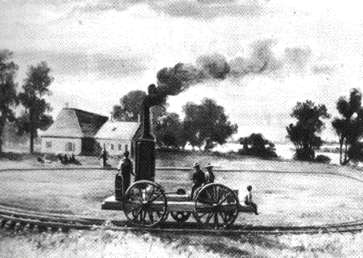
The first steam locomotive built in America was the work of John Stevens, who constructed an experimental engine in 1825 and ran it on a circular demonstration track at his estate in Hoboken, New Jersey. The machine was not intended for regular service but served to prove that steam locomotion was practical on rails. Stevens had long championed the idea, and on March 21, 1823 he secured a charter to build a steam-powered railroad in Pennsylvania, underscoring his role as a pioneer of the technology.
Stevens's demonstration helped convince skeptical Americans that steam-powered rail travel was feasible at a time when canals dominated transportation planning. Though his Hoboken locomotive remained an experiment, it inspired further efforts that soon produced working locomotives such as Peter Cooper's Tom Thumb in 1830. By showing what steam power could achieve on rails, Stevens helped carry American railroading from curiosity to a transformative force within a single generation.