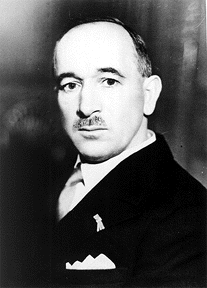
Edvard Beneš was a Czechoslovak statesman who helped found his country and twice served as its president, a leading figure of interwar European diplomacy whose career was bracketed by the two great catastrophes of Nazism and communism. Born in Bohemia under Austro-Hungarian rule, he studied in Prague and Paris and became a sociology professor before turning to politics.
During the First World War, Beneš worked abroad with Tomáš Masaryk to win Allied support for an independent Czechoslovakia, and when the new state was created in 1918 he became its long-serving foreign minister. A tireless internationalist, he was a champion of the League of Nations and of collective security in the 1920s and 1930s.
He became president in 1935, only to face the gravest crisis of his career. In 1938, abandoned by Britain and France at the Munich Conference, Czechoslovakia was forced to surrender its border regions to Nazi Germany; Beneš resigned and went into exile as Hitler dismembered his country.
He led the Czechoslovak government-in-exile in London through the Second World War and returned in triumph in 1945 to resume the presidency. But the postwar reprieve was brief: in 1948 the communists, backed by Moscow, seized full power in a coup. The ailing Beneš, unwilling or unable to resist, soon resigned, and died later that year as his country fell behind the Iron Curtain.