 >
>
The treaty of Versailles was signed on June 28, 1919. The Allies negotiated the treaty among themselves for five months with negotiations beginning on January 18th, before presenting it to the Germans as a fait accompli. The treaty was harsh forcing the Germans to pay reparations and give up significant territory.
Under the terms of the ceasefire that ended the fighting, German troops withdrew from all the territory that they held in Belgium and France. The Allies also were entitled to occupy the Rhineland which they did. However, the agreement was a ceasefire and not a peace agreement. Thus the Allied leaders met in Paris to negotiate a peace agreement. The negotiations were not with the German but rather among the Allies who had somewhat differing objectives.
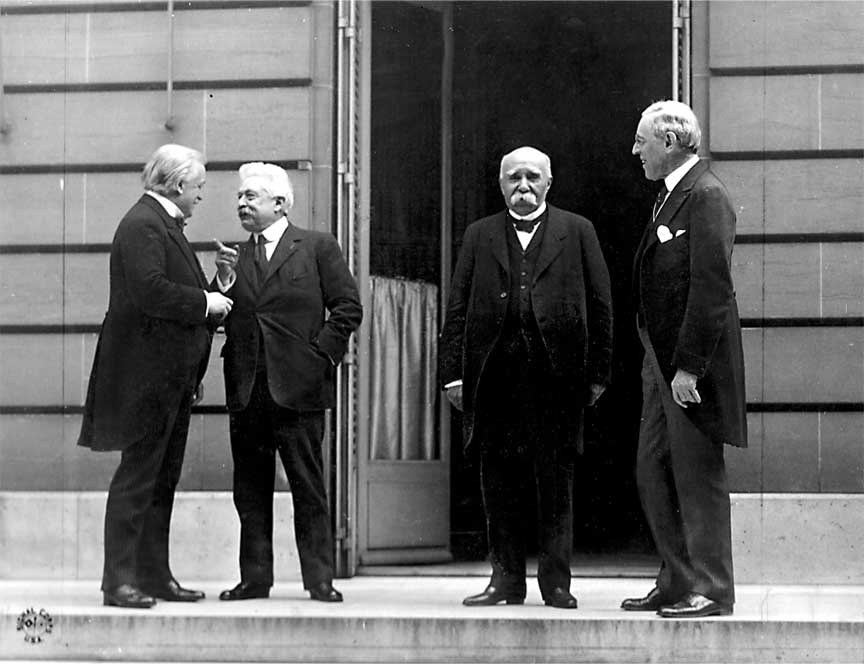
The French had been the most devastated by the war. Their mines had been flooded, their countryside had been one big battlefield, and their youth had been gutted, having lost 1.3 million men representing 25% of the men between the ages of 20-30. They were also the most vulnerable in case of another war(a concern that certainly proved true 20 years later). The French-led by George Clemenceau wanted three things from a peace conference, money to rebuild, a Germany that would be too weak ever to attack again and a little revenge. The British led by David Lloyd George who had not suffered nearly as much as the French and while wanted to weaken Germany wanted to make sure she was strong enough to remain an important trading partner with England. President Wilson leading the American delegation wanted a peace agreement that adhered as much as possible to the 14 Points he had outlined in his speech.
Talks began on January 18, 1919. Initially, 70 delegates from 29 nations participated in the negotiations. Quickly, however, the real negotiations took place with the big four- the leaders of France, England, and the United States, and then just the big three. The three and four men met for 145 times negotiating between themselves the treaty that the German would have to sign.
It took five months, but by June the Allies had worked out the treaty. They then demanded that the German sign the agreement. When the Germans refused the Allies threatened to resume the war, a war that the Germans were in no condition to fight. The German acquiesced, and on June 28, 1919, the Treaty was signed.
Under the Treaty's terms, Germany was forced to cede substantial territories, including Alsace-Lorraine. West Prussia was given to Poland, and the Polish "corridor to the sea" was created. The Saar, a coal-rich region, was put under French control for 15 years, and the Rhineland was to be occupied by the Allies for 15 years and then permanently demilitarized. Germany was to maintain an army no larger than 100,000 men, with no air force, and a navy of 6 ships. Germany was also forced to pay reparations of 20 billion marks. Lastly, the League of Nations was created.
The Peace of Versailles bore little resemblance to Wilson's "Fourteen Points."