The Sinai-Suez Campaign
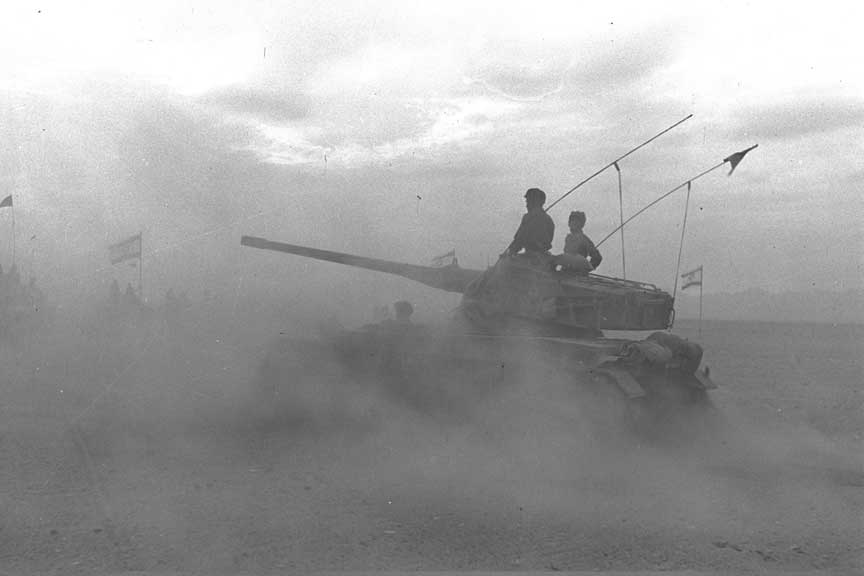
1956 Sinai Suez Campaign.
Israeli tanks entering the Sinai
On October 29th 1956 in secret coordination with the French and British Israel troops attacked Egytpian troops in the Sinai and Gaza Strip. The Israeli swiftly captured most of the Sinai while the French and British landed on Suez Canal. All the forces were pressured to withdraw by international pressure.
Following the Israeli War of Independence, the British, Americans and French, by mutual agreement, did not supply either the Israelis or the Arabs with significant quantities of armaments. In October 1955, Egypt signed an arms deal with Czechoslovakia, which provided Egypt with very substantial amounts of weaponry. The arms deal, combined with continued fedayeen (armed terrorist) raids in southern Israel, convinced Israeli leaders that steps would have to be taken to alleviate the situation and that this would have to be done before Egyptian forces were able to achieve strategic predominance in the area.
On July 26th, 1956, Egyptian President Nasser nationalized the Suez Canal. This gave the British and French--who had already been selling Israel advanced weapons--a significant motive for cooperating with an Israeli attack on Nasser.
On October 29th, 1956, the Israeli Defense Forces attacked Egyptian forces in the Sinai. Israel rapidly defeated the Egyptians, with a loss of just 180 men. The Egyptians suffered over 1,000 fatalities, and more than 6,000 Egyptians were captured as prisoners of war. The Israeli forces halted 10 miles short of the canal, allowing the British and French troops to intervene to protect the canal. The British and French soldiers then attacked and occupied the canal zone.
Sustained American pressure, backed up by Russian threats, forced the British and French to withdraw. The Israelis were similarly pressured. Ultimately, Israel was forced to withdraw from the Sinai and Gaza Strip. In return, the Straits of Tiran were opened for Israeli shipping, and a U.N. force was placed in the Sinai and Gaza Strip as a buffer.
About
American history and world history can be found at historycental- History's home on the web. Explore our complete time lines of major events in American history as well as World History. Research our special sections on diverse subjects ranging from presidential elections to naval history. Whatever aspect of history you wish learn about, you will find it at Historycentral.com.
Take A Look
Civil War
US Navy
JFK Historymaker
Popular Categories
© 1996-2020 Historycentral.