 >
>First 100 Days
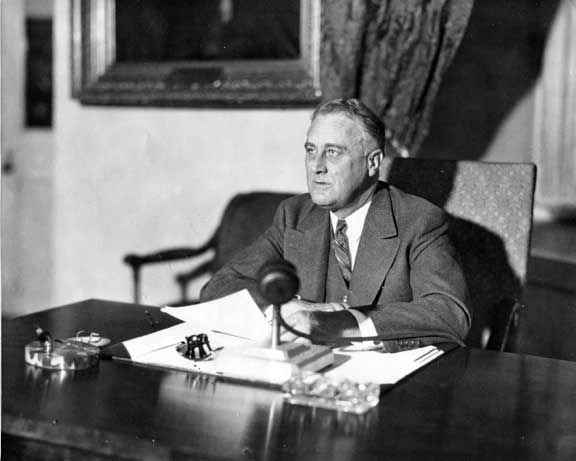
Fireside Address
More was accomplished in the first 100 days of the Roosevelt Administraiton the almost any other period in US history. Fifteen major laws were passed during these 100 days.
There will probably never be another period like the first 100 days of the Franklin Delano Roosevelt Administration. Never in U.S. history did the country face such enormous economic challenges. Furthermore, never had a new President taken office possessing such great self-confidence that he would be prepared to grapple with the breadth and depth of the nation's problems. That being said, Roosevelt knew he would have to move quickly. In addition, and most importantly, FDR understood he had to keep the press and public fully informed. So began the first 100 days of the Roosevelt administration.
The first morning after his inauguration, President Roosevelt met with the press. Two days later, FDR spoke to the American people; in what would become the first of the 30 "Fireside Chats" he would give over the course of his four terms as President. Roosevelt also swiftly called the Congress into session, in what led to a whirlwind of legislative accomplishments.
The first bill to be passed during the Roosevelt administration was the Emergency Banking Act. The House passed the Act unanimously. Within a few days, the Act was passed the Senate and then signed into law. Another bill to cut back government salaries followed the Emergency Banking Act. The cutback bill passed, despite some unease on the part of Democrats. The repeal of the Volstead Act; or "Prohibition" was the next piece of legislation raised. Congress quickly approved the Volstead Act as well. Next, Congress, (primarily elected on Roosevelt's coattails) voted in favor of a comprehensive Farm Bill. For any other President, these victories would have been enough. However, Franklin D. Roosevelt was just getting started.
With the first set of legislative accomplishments under his belt, FDR had Congress pass legislation authorizing the Civilian Conservation Corps, one of Roosevelt's groundbreaking ideas. Then, FDR succeeded in creating the Federal Emergency Relief Agency. After which, Roosevelt shepherded new legislation through Congress to regulate Wall Street. FDR's legislative vision and skill to implement innovative, effective programs went on and on. Roosevelt asked for and received authorization to create the Tennessee Valley Authority. The T.V.A. built dams and generated electricity for one of the most impoverished areas in the United States. FDR then convinced Congress to swiftly establish the Home Owners' Loan Corporation to stop the foreclosures of American homes.
Still, Roosevelt was not yet done. Before his first "Hundred Days" were over, Roosevelt requested and had approved a $3 billion "Public Works" bill and the "Glass-Steagall Act" to divest banks of investment. The Glass-Steagall Act included a Housing Act, as well as a Railroad Reorganization Act, and finally, the National Industrial Recovery Act.
In his first one hundred days, (that ended on June 16th,) FDR sent 15 special messages to the Congress. The Congress responded by enacting 15 landmark laws. If that was not enough, FDR pushed further and took the United States off of the "Gold Standard," and successfully convinced the second Bonus Army to disband.