 >
>Battle of Thames
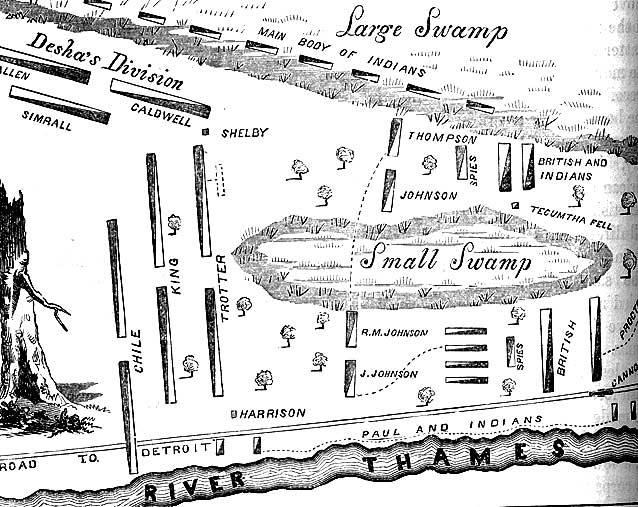
After the American victory at Lake Erie, forces crossed the lake into Canada on October 5, 1813 at what became known as the Battle of Thames. British forces commanded by General Proctor were forced to withdraw. The American forces catch up with the surrendering British and Indians and decisively defeat them. Tecumseh, the Indian chief, was killed in the battle.
.
The Creek Indians posed a persistent threat in the southern region. Following the Massacre at Fort Mims, a significant campaign was devised to eliminate them, capitalizing on the American victory at Lake Erie. General William Henry requested Kentucky Governor Isaac Shelby to lead the Kentucky Militia into battle. Approximately 3,000 Kentuckians embarked on the campaign, and in late September, the American forces successfully recaptured Detroit. Recognizing the Americans’ control over Lake Erie, British Commander General Proctor understood his position was untenable. Consequently, Proctor led his British and several Indian troops in a retreat. Approximately 50 miles east of Detroit, Proctor made a stand. Upon receiving reports of extremely thin British lines from American scouts, Harrison devised a daring strategy: a cavalry assault by the Kentucky troops directly against the British lines. The British were unprepared for this type of assault, and when the initial wave of horsemen swiftly breached the British lines and turned on them from the rear, British troops promptly surrendered. Subsequently, the American forces proceeded to defeat the Indian allies, resulting in the deaths of most of them, including Tecumseh.