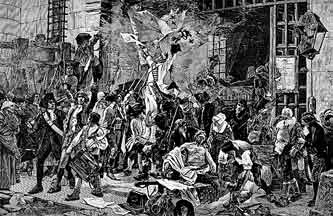
National Assembly Establishes Constitutional Monarchy
Following the outbreak of the French Revolution in 1789, the National Constituent Assembly worked to replace the absolute monarchy with a government grounded in popular sovereignty and the Declaration of the Rights of Man and of the Citizen. After two years of debate, and despite the king's failed flight to Varennes in June 1791, the Assembly completed a written constitution.
The Constitution of 1791 transformed France into a constitutional monarchy in which King Louis XVI retained executive authority and a suspensive veto but was bound by law. Legislative power rested with a single-chamber Legislative Assembly of 745 elected representatives. Voting rights were limited to so-called active citizens who met a property and tax qualification, excluding the poorer population from the franchise.
The new framework took effect in the autumn of 1791, but the constitutional monarchy proved short-lived. Mutual distrust between the king and revolutionaries, war with Austria and Prussia from 1792, and rising radicalism undermined the settlement. The monarchy was overthrown in August 1792, the Republic proclaimed in September, and Louis XVI executed in January 1793, opening a far more turbulent phase of the Revolution.