Grumman E-2C Hawkeye
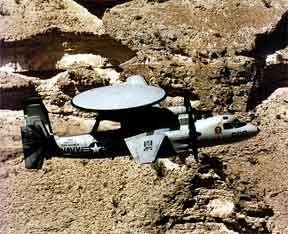
The E-2C Hawkeye is a carrier-based airborne early warning and control aircraft built by Grumman (later Northrop Grumman). Distinguished by the 24-foot rotating radar dome, or rotodome, mounted above its fuselage, it provides the U.S. Navy with all-weather airborne surveillance, command and control over the battle area, detecting aircraft, ships and missiles at long range and directing friendly fighters and strike aircraft. The Hawkeye design first flew in 1960, and the improved E-2C entered fleet service in 1973, becoming the standard early-warning aircraft of the carrier air wing.
Powered by two Allison T56 turboprops and crewed by two pilots and three radar and combat-information officers, it can patrol for hours far from the carrier, serving as the eyes and command node of the strike group. Successive radar and avionics upgrades, including the E-2C Group II and Hawkeye 2000, kept it effective for decades before the E-2D Advanced Hawkeye followed.
Specifications
- Manufacturer
- Grumman Aerospace
- Type
- Carrier-based airborne early warning and control aircraft
- Crew
- 5 (two pilots, three systems operators)
- First Flight
- October 21, 1960 (E-2 series)
- Powerplant
- 2 x Allison T56-A-425/427 turboprops, approx. 5,100 shp each
- Max Speed
- Approx. 350 kn (404 mph; 648 km/h)
- Range
- Ferry range approx. 1,540 nautical miles (2,850 km)
- Service Ceiling
- Approx. 30,000 ft (9,150 m)
- Length
- 57 ft 9 in (17.6 m)
- Wingspan
- 80 ft 7 in (24.6 m)
- Loaded Weight
- Max takeoff approx. 53,000 lb (24,000 kg)