McDonnell Douglas F-15 Eagle
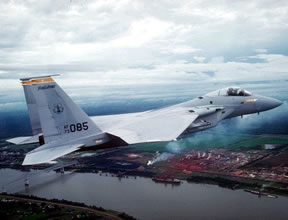
The McDonnell Douglas F-15 Eagle is a twin-engine, all-weather air superiority fighter designed to gain and hold control of the skies. First flown on July 27, 1972, it entered Air Force service in 1974 as the service's premier dogfighter, conceived in response to advanced Soviet fighters. Its high thrust-to-weight ratio and large wing area give it exceptional maneuverability and acceleration; it was the first U.S. fighter able to accelerate while climbing vertically.
Powered by two Pratt & Whitney F100 turbofans, the Eagle carries a 20mm cannon along with radar-guided AIM-7/AIM-120 and heat-seeking AIM-9 missiles. Produced in single-seat (A/C) and two-seat (B/D) versions, it compiled a remarkable combat record, downing 36 Iraqi aircraft during Operation Desert Storm in 1991 without an air-to-air loss. With more than 100 victories and no defeats across all operators, the F-15 remains among the most successful fighters ever built.
Specifications
- Manufacturer
- McDonnell Douglas
- Type
- Air superiority fighter
- Crew
- 1 (2 in B/D models)
- First Flight
- July 27, 1972
- Powerplant
- 2 x Pratt & Whitney F100 turbofans, approx. 23,000 lbf each with afterburner
- Max Speed
- Mach 2.5 (over 1,600 mph)
- Range
- 3,450 miles with external tanks
- Service Ceiling
- 65,000 ft
- Length
- 63 ft 9 in
- Wingspan
- 42 ft 10 in
- Armament
- 1 x 20mm M61 cannon, AIM-7/AIM-120 and AIM-9 missiles, plus external ordnance