1945-Contin
ued
in May of two
CVEs
with Marine Carrier Air Groups on
board marked the combat debut in Marine Air Support
earners.
Task Force 57 (Vice Admiral H. B. Rawlings, RN), a
British task force built around four carriers equipped
with armored flight decks, operated south of Okinawa
(26 Mar-20 Apr and 3-25 May), from which position it
neutralized airfields on Sakishima Gunto and Formosa,
and intercepted air raids headed for the assault area.
Subject to frequent suicide attacks, all four carriers
took hits in the course of their action, but all remained
operational.
Patrol squadrons of Fleet Air Wing I, based on sea-
plane tenders at Kerama Retto, conducted long-range
antishipping search over the East China Sea to protect
assault forces from enemy surface force interference,
flew antisubmarine patrols in the immediate area, and
provided air-sea rescue services for carrier operations
from D minus I day to the end of the campaign.
Army and Marine Corps troops landed on the west-
ern shores (I Apr) against light opposition, established
a firm beachhead, and captured Yontan airfield the
same day. Supporting shore-based air moved in
behind the landings led by the OY-I spotting planes
(3 Apr). As ground opposition stiffened, Marine Corps
elements of the Tactical Air Force began local air
defense patrols (7 Apr) and shortly started their close
air support mission. A Navy landplane patrol squadron
joined forces ashore (22 Apr) and extended the range
of seaplane search operations, and an Army fighter
squadron began operations from Ie Shima (13 May).
Strong Japanese air opposition developed (6 Apr) in
the first of a series of mass suicide attacks involving
some
400
aircraft. In seven mass raids, interspersed
with smaller scattered ones, during the critical period
(6 Apr-28 May), the Japanese expended some 1,500
aircraft, principally against naval forces supporting the
campaign. In the three month's struggle against the
humanly guided missiles of the Kamikaze force, the
U.S. Navy took the heaviest punishment in its history.
Although Task Force 58 lost no carriers during the
campaign, one light and eight heavy carriers were hit:
Enterprise, Intrepid, Yorktown
(18 Mar),
Franklin,
Wasp
(19 Mar),
San Jacinto
(6 Apr),
Hancock
(7 Apr)
Enterprise, Essex,
(II Apr)
Intrepid
(16 Apr)
Bunker
Hill
(II May), and
Enterprise
(14 May). Three
escort
carriers of Task Force 52,
Wake Island
(3 Apr),
Sangamon
(4 May), and
Natoma Bay
(6 Jun), were
also damaged.
Opposition from Japanese naval surface forces was
brief and ineffective.
A
task force made up of
Yamato,
the world's largest battleship, one light cruiser, and
eight destroyers, took part in what was to be the last
UNITED STATES NAVAL AVIATION
1910-1995
151
sortie by the Japanese Navy and was beaten decisively
by carrier aircraft in the Battle of the East China Sea (7
Apr). Only four Japanese destroyers survived the
encounter.
Carrier air support was on a larger and more exten-
sive scale than any previous amphibious campaign.
Fast and escort carrier planes flew over 40,000 action
sorties, destroyed 2,516 enemy aircraft, and blasted
enemy positions with 8,500 tons of bombs and 50,000
rockets. Marine Corps squadrons ashore destroyed
another 506 Japanese aircraft and expended 1,800 tons
of bombs and 15,865 rockets on close air support mis-
sions. Task Force 58's time on the line (18 Mar-IO Jun)
was surpassed by the escort carriers (24 Mar-2I Jun),
but of several records for continuous operations in an
active combat area that were marked up by the carri-
ers during the campaign, the most outstanding was
logged by
Essex,
with 79 consecutive days.
21 March
The development of a rocket-powered
surface-to-air guided missile, was initiated as the
Bureau of Aeronautics awarded a contract for 100
experimental Larks to the Ranger Engine Division of
Fairchild.
26 March
Commander, Fleet Air Wing I, based on
Hamlin,
arrived at Kerama Retto to direct the opera-
tions of patrol squadrons assigned to support the
assault and capture of
Okinawa.
14 April
Commander, Fleet Air Wing 10, arrived at
Puerto Princessa, Palawan, to direct patrol plane oper-
ations against the shipping in the South China Sea and
along the Indo-China coast.
23 April
PB4Ys of Patrol Bombing Squadron 109
launched two Bat glide bombs against the enemy
shipping in Balikpapan Harbor, Borneo, in the first
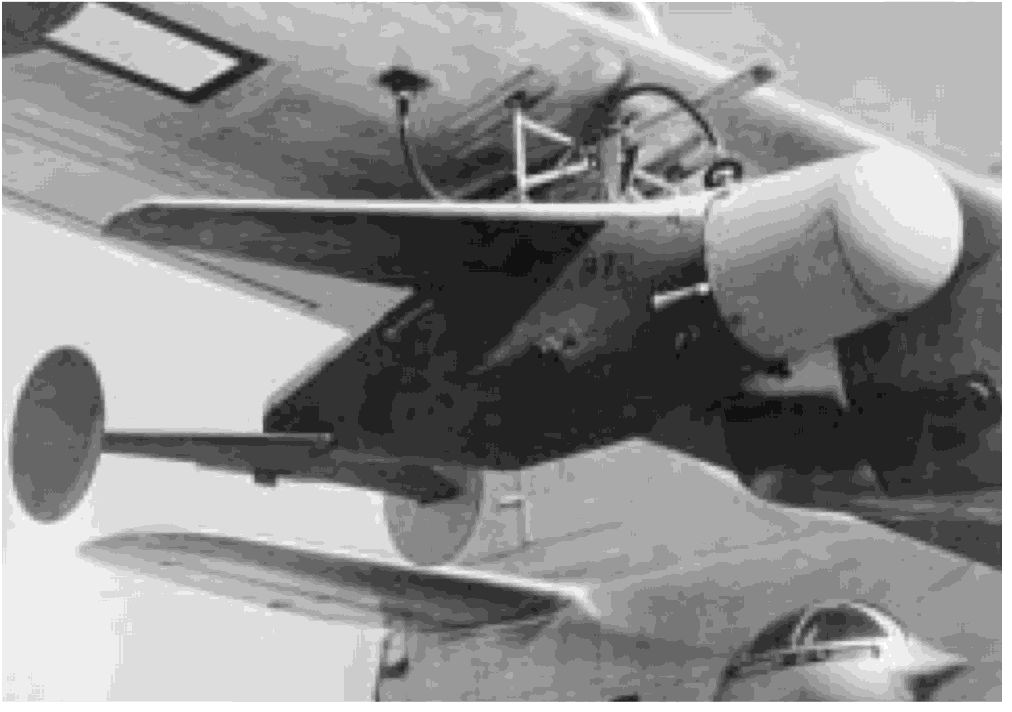
Bat, WWII automatic homing Navy missile 701606
|
1 |
 |