 >
>1954 Brown v Board of Education
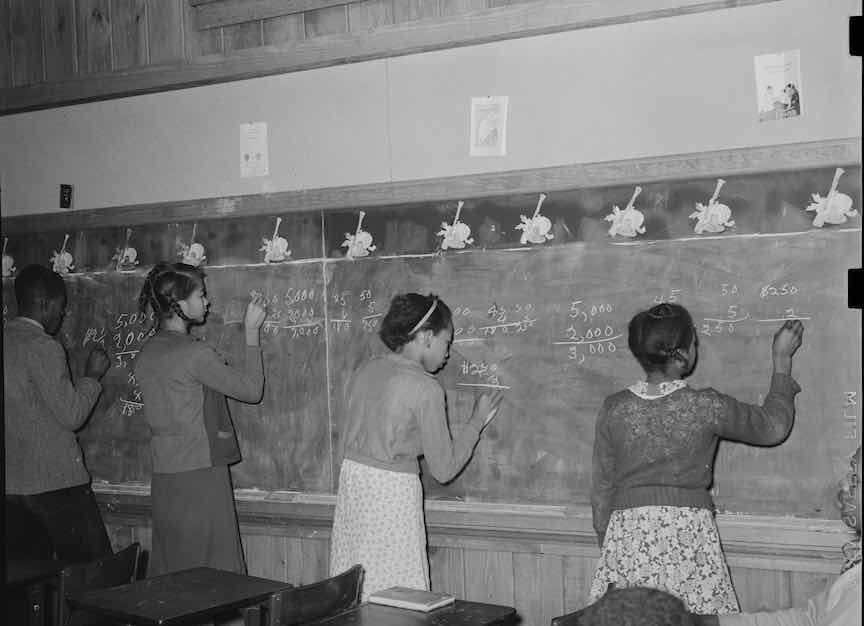
School
In 1950, the NAACP changed its tactic in its fight against discrimination against blacks. It decided, for the first time, to try to challenge the earlier Supreme Court ruling, Plessy vs. Ferguson, of 1896, which had stated that segregation was legal as long as the schools in question were equivalent.
Brown vs. the Board first came to the Supreme Court in 1952, and the head of the NAACP legal fund, Thurgood Marshall, argued the case. In 1954, the Supreme Court ruled that separate facilities were inherently unequal. It stated that schools could no longer remain segregated. This landmark decision provided the impetus for much of the desegregation of America that was to follow.
In 1896 the Supreme Court had ruled in the case of Plessy v Ferguson that separate but equal in rail transportation was legal. That ruling had allowed school district all over the United States to set up different schools for African American and White students. The NAACP had waged a public fight against the status since its founding. In 1950 it decided it was time to attack the very legal foundation of segregation and that was the Plessey ruling.
In 1951 a class action suit was filed against the Board of Education of the City of Topeka Kansas. Thirteen parents sued on behalf of their 20 students. The suit demanded that the board of education end their separate but equal elementary schools. The names plaintiff was Oliver Brown one of the parents who worked as a welder for the Sante Fe Railroad. Each of the parents in the suite tried to enroll their children at a nearby White Elementary School but were refused and instead told they must send their children to an African American school much further from their house.
The case was heard in US District Court. That court ruled based on Plessey vs. Ferguson that although the separate education was no doubt detrimental for the students, the two schools were similar in both facilities, teachers and equipment thus it was legal.
The case was then brought to the Supreme Court. Representing the plaintiffs at arguments that were held the first time in December 1952 was Thurgood Marshall. The United States entered an amicus brief where it argued that discrimination was adversely affected the United States foreign policy since it was an embarrassment in the world to have it.
It was important for the decision to be unanimous, or so thought justice Felix Frankfurter, so he had the sides return in December 1953 to reargue the case. This time after a significant internal argument the justices all agreed. On May 17, 1954, the decision was handed down. The court ruled that “Separate educational facilities are inherently unequal. Therefore, we hold that the plaintiffs and others similarly situated for whom the actions have been brought are, because of the segregation complained of, deprived of the equal protection of the laws guaranteed by the Fourteenth Amendment.”